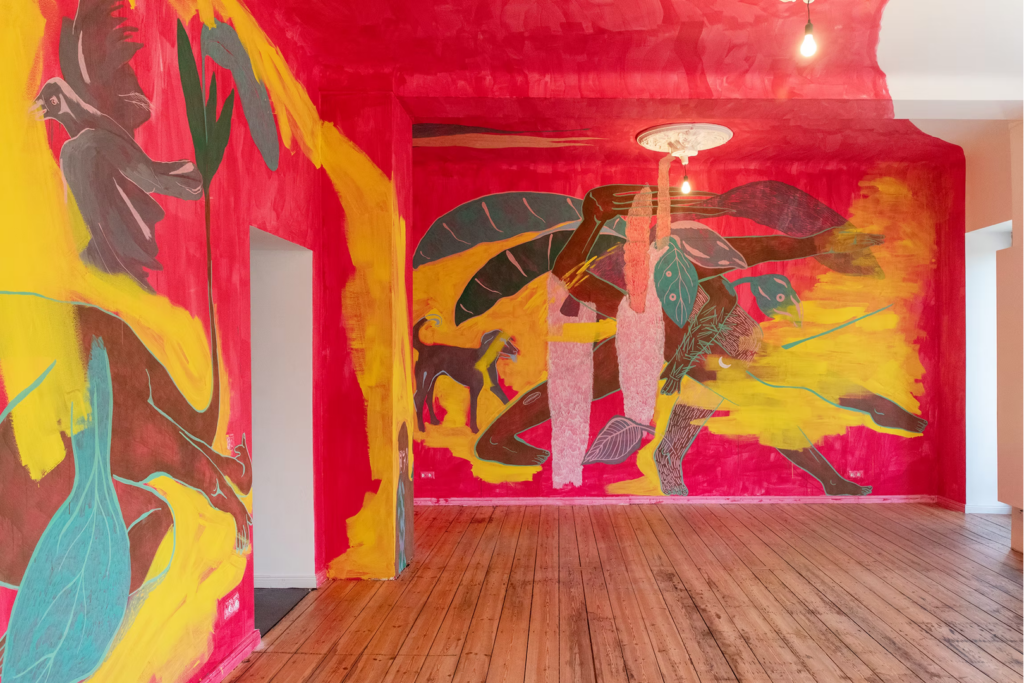
Last year, I had the opportunity to contribute to Arijit Bhattacharya’s beautiful and poignant exhibition A Handful of Truths in a Mouthful of Lies, together with Rimil Umul Collective, Shubhangi Derhgawen, Amtus Stanislaus Kuyil and Jad Salfiti.
In connecting scholarship on Orientalism and Islamic/Middle Eastern Studies, gentrification, antisemitism and anti-communism, I tried to contextualize political and police repression, and the increasingly adverse and openly hostile circumstances for many of us working in or with political spaces or cultural institutions, dependent on dwindling goodwill and funding.
The booklet that includes this text was printed by our friends at we make it.
If it reached you in print, please let me know.
During the past ten to twelve years I have seen police brutality manifest in many different situations. There were many rallies and marches, often focusing on anti-racism, freedom of movement and the right to housing, education and employment for refugees and migrants or protests against deportations or forced evictions. Cries for equality and social justice have always been met with force and repression – legally, like the banned commemoration of the racist Hanau massacre – or through intimidation and arrests in cases that wouldn’t have any real substance in court, like showcasing “ACAB”-prints, and severe violence during those arrests. From the 2014 eviction of the refugee camp at Oranienplatz to the eviction of the self-organized space at the former Gerhart-Hauptmann-Schule, I could observe heightened police presence and arbitary arrests of Africans on a daily basis. My apartment in Kommandantenstraße, just a few minutes from Oranienplatz, was packed with police cars during many of these days. 1720 police sealed off four blocks in Berlin Kreuzberg to make sure none of the infrastructure could be rebuilt. The area was under siege and could only be entered by residents providing their ID. Racial profiling increased.
When we organized school and university strikes in solidarity with the refugees in Berlin and other German cities, we also criticized other aspects of German politics home and abroad, like Frontex drowning people in the Mediterranean, the Khartoum Deal and Germany’s financing of the Sudanese Janjaweed as well as the German military training the Libyan coast guard that captured refugees and sold them into slavery. Our position in solidarity with Palestinian refugees was enough for some to accuse the school strike of antisemitism.
However, there is a significant difference between ‘ordinary’ police violence as infringement of democratic rights and attempted intimidation of dissent, and the outright siege—or occupation—of a complete neighborhood. It is not by accident that the militarization of Kreuzberg ten years ago aimed at refugees, non-citizens and their supporters, given decades of anti-migration rhetoric and equivalent legislation. Similar to the way in which the presence of refugees in public space challenges ideas that refuse to acknowledge their humanity, the presence of Palestinians in public space needs to be policed. The figure of the refugee and the migrant have to legitimize their presence through helplessness and obedience which stands in contradiction to the intentional expression of political consciousness.
Aspects of the Israeli military occupation of Palestine have been incorporated into the policing of their own neighborhood.
Liz Fekete, “Anti-Palestinian Racism and the Criminalisation of International Solidarity in Europe,” Race & Class 66, no. 1 (2024): 103–4.
Those “who live in Berlin-Neukölln, where there has been an intensification of police repression since the war in Gaza, now feel as though aspects of the Israeli military occupation of Palestine have been incorporated into the policing of their own neighborhood: for instance, brutal policing of demonstrations, stationing of riot police in Sonnenallee (known as Berlin’s ‘Arab Street’) for three days in a row, installation of checkpoints and increasing numbers of house arrests.”1 Anna Younes describes the appearance of mechanisms of policing and surveillance reminiscent of settler-colonial contexts as settler-coloniality.2 After October 7, 2023, there were at one point 850 police deployed around Sonnenallee according to RBB. This year, there were at least 1500 police deployed across the city. The current trend is an intensification of the repression faced by activists, refugees and poor people in general. In the case of Neukölln, there are multiple intersecting dynamics that intersect in the production of a securitized area in which policing and controls reminiscent of colonial methods appear.
The legal justice fund 3ezwa mentions thousands of cases of state repression in Berlin alone. The cultural dimension of this violence and how it connects both European and Israeli expressions of colonialism is made clear by bans of Arabic, Hebrew and even Gaelic slogans, signs and songs on marches. This also extends the German cultural and educational politics of banning languages like Arabic, Kurdish or Turkish from schoolyards, complementing the absence of colonial history and marginalized geographies within the classroom.
Palatable Deaths
“There is indeed no other country as apathetically silent like this in the face of the Gaza horror—not even, and certainly not, the United States, the only other remaining supporter of Netanyahu’s one-state solution. It is hard to believe that this should be due to a deeply felt widespread sense of guilt over the Nazi genocides; much more likely, it is Angst of being excluded, with the blessing from the highest ranks of philosophy, from the official German Schuldgemeinschaft.”3
Over the past decade, critical scholars have noted a rise in attempts to silence Palestinian (and Kurdish) activism and anyone who stands in solidarity. Scholars, artists, cultural practitioners and activists have long experienced political pressures when simply inviting or cooperating with Palestinian artists, thinkers as well as activists. The results have been cuts of funding, jobs, or access to spaces. The expression of political dissent, whether voiced by Palestinians or Jews, whether advocating for workers’ direct action against super-exploitation, economic or cultural boycotts, an end to illegal settlements, the right for refugees to return is regularly met with suspicion and seen as contrary to German values. In much of the global media economy October 7, 2023, serves as a singular point of reference, taken out of its historical context. The Shoah explains the necessity of a Jewish state, but colonialism, racism and European antisemitism explain the alliance of colonialists, imperialists and Zionists that predates German fascism. Likewise, there is much effort in Germany to undermine the commemoration of the Nakba in 1948, and the attempt to do so has been prohibited and criminalized for a number of years. It is urban folklore that some clubs and cafés wouldn’t let anyone enter wearing a Keffyieh—now anyone could get arrested in the streets for wearing it at the wrong time in the wrong place. Writing on the politics of German anti-anti-Semitism, Wolfgang Streeck reminds of the many structural and individual connections between the Reich and the Republic. “What exactly the Federal Republic did to get Israel to forget who they were dealing with we don’t know,” the author ponders.4 He recounts his own encounters with the colonial mythology transmitted to the Germans:
“In schools in the late 1950s, well before the Auschwitz trials, movies were shown of life in the kibbutz, and Israelis were commended for turning the desert, left barren by the Arab nomads, into productive farmland where they grew oranges and other delicious fruit and vegetables. Teachers who were former Nazis, this writer remembers, were full of admiration for Israel’s citizen soldiers: everyone had to serve, even women; there were, it was claimed, no conscientious objectors; military service took long and training was demanding. There was hardly any mention at the time of what later became known as the Holocaust, and none of the Nakba. Essentially, Germans learned that the state of Israel had been founded on uninhabited land.”5
In the 1960s, the Adolf Eichmann trial, the Auschwitz trial and the radicalized student movement forced Germany to address its Nazi past. But “Germany’s almost exclusive focus on the Holocaust has enabled blatant ignorance of German colonial crimes. Insistence on the Holocaust’s singularity or exceptionality—while emotionally understandable given its monstrous scale—is analytically problematic, as it takes the Holocaust out of ‘normal history’,” and leads to “ignoring the prevalence of genocidal tendencies in Germany long before 1933, as well as racist continuities that stretch until today.”6
Constructing Islam as a Threat
The construction of Islamic cultural belonging and identity as a threat reaches back to Southern Europe in the 15th and 16th century—exemplified by the oppression, forced conversion, assimilation or expulsion of African, Arab and Imazighen from the Iberian Peninsula.7 European colonialism eventually reorganizes pre-modern color prejudice into its contemporary form that is based on the assumption of the existence of different human races; while racism is modernized, the primitive is further inscribed in its objects, and the uncivilized peoples are born. European social and natural sciences go to great lengths to establish the existence of “People without History.” Eventually, the old racism that appealed to biology “becomes transformed into cultural racism. The object of racism is no longer the individual man but a certain form of existing.”8 “‘Occidental values’ oddly blend with the already famous appeal to the fight of the ‘cross against the crescent’.”9 Islam and Muslims can at the same time be constructed as internal and external threats. This in turn leads to criminalization, surveillance and policing of Muslims as ‘would-be perpetrators.’10 Comparing trajectories of Middle Eastern Studies internationally, Loimeier concluded more than twenty years ago, that while we live in the time of Talal Asad and Maxime Rodinson, German scholars are primarily oriented toward linguistics and explicitly reject social and political studies, thus Orientalist concepts are revived in times of crises.11 He notes further that the discipline still appears to explain anything that happens in ‘Oriental’ countries with ‘Islam’, while the public is still dependent on “politicians, lobbyists, intellectuals and journalists, that don’t know ‘Islam’.”12
via the discursive omission of Palestine, colonial contexts, and settler violence through time and space, these educational archives also produce the very desire for these threatening bodies to be ‘kept out.’
Anna Younes and Hanna Al-Taher, “Erasing Palestine in Germany’s Educational System: The Racial Frontiers of Liberal Freedom,” Middle East Critique 33, no. 3 (2024): 404.
People with biographical or family connections are at the same time seen as too emotional and hence unprofessional, or simply not distanced enough to be objective. A person experiencing racism might hence be invited to share instances of racist discrimination, but without the attempt to connect these individual experiences to structural racism. Liz Fekete recounts the experience of Palestinian academic Ghada Karmi, who was told “‘give me your answer, but don’t tell me the history of the situation’.”13
Colonial minister Wilhelm Solf’s claim “that the impact of Islam on the indigenous peoples has proved not to be favorable. Islam has accomplished nothing in the larger world; it is no culture-carrier” could as well be read in contemporary conservative newspapers.14 Marchand notes”the presumption that non-European culture was something to master and own, not an ongoing living set of traditions into which one entered as a guest. Most orientalists did not really want to hear the voices or see the faces of real-existing ‘oriental’ peoples”.15 Younes and Al-Taher connect the one-sidedness of contemporary education to the need for securitization. Their work demonstrates that “via the discursive omission of Palestine, colonial contexts, and settler violence through time and space, these educational archives also produce the very desire for these threatening bodies to be ‘kept out,’ removed, or eradicated to keep Europe and its liberal order of self-proclaimed ‘freedom’.16
Silencing Solidarity
Historically, Neukölln was home to precarious German workers and to guest workers who had to accept lower quality, lower wage jobs while simultaneously paying more rent for worse housing. As a relative surplus population, unemployment is highest among migrants, while unemployment of both German and migrant workers is higher in Neukölln than in other parts of the town. Beginning in the early 1980s until the mid-2000s, the mode that governed the reproduction of surplus workers shifted from welfare to workfare, as welfare and social services became more profit-oriented. This process resulted in “the monetisation of socio-spatial reproduction and its target policies of repression of the undeserving poor and integration of non-integrating foreigners in Neukölln.”17 At the same time, the district was framed as marked by deprivation, crisis and social issues, constructing migration and migrants as ‘problem’. Neukölln is portrayed as home to a parallel society in which muslims live in a segregated community and refuse to participate in society. Media write of “terror schools” and a “war of attrition” between teachers and students.18 The war on Palestine renewed this focus on Neukölln schools as battlegrounds. In addition to other politicians who made similar remarks, far right AfD leader Björn Höcke stated notoriously that Neukölln was no longer a part of Germany.
Many of the places that serve social functions, as well as businesses run by migrants are routinely accused of money laundering or tax fraud and subjected to police raids. Germany’s own politics as the root cause of this disastrous situation is still seldom openly addressed. In this context, territorial and racialized stigma work “to maintain and deepen the racialized hierarchies that enable dispossession, exploitation and coercion.” Accordingly, strategies of profit maximization “must be read in conjunction with the marginalization of already vulnerable communities, such as the elderly, the disabled, mentally ill people, drug users, single mothers and racialized minorities.”19 Especially people that are already vulnerable can remain stigmatized while their neighborhood is already changing, resulting in a “dialectical interplay between territorial and racial stigma.”20 Financialized gentrification aimed at maximizing profit rates in turn enforces “measures such as increased policing in front of schools, the securitization of public spaces and dispelling of unwanted users such as drug users and migrant youth.”21
Tactics that have been developed in colonial contexts, for example in Kurdistan or Palestine, travel to the European borders where they are deployed against refugees and despite countless efforts often remain undocumented.
Against the backdrop of the fearmongering about ‘clan criminality’ and escalating police violence in urban areas much like Neukölln, Vanessa Eileen Thompson connects modes of policing and carcerality to conceptualize what she calls carceral racism.22 She reminds that policing “encompasses various modes of societal control”, with NGOs and welfare agencies being perpetrators as well, while labor and migration are intersecting targets. She further notes the constitutive role of the media, with police reports functioning as privileged sources and exaggerated reports further legitimizing stronger police presence.23 Thompson mentions that in “the debate around ‘clan criminality,’ for instance, religion and the naturalization of cultural differences function as markers for ‘criminal behavior’.”24 Palestinian political activism thus merely becomes one additional element that constitutes criminal behavior and rationalizes an even more brutal repression of an already over-policed population, district and political constituency. The police becomes more and more hypermilitarized, acting as “de facto paramilitary squads” which show stunning similarities with colonial policing.25 Hypermilitarization blurs the boundaries between domestic and foreign policy, threats of national security and crime and further enforces practices such as racial profiling, raids and bans of groups and organizations like the Palestinian prisoner solidarity network Samidoun because of its alledged connections to the Popular Front for the Liberation of Palestine. The Kurdish Mezopotamien Press had been banned in 2019 with a similar scheme. Fekete also emphasizes the prevalence of understanding society and social issues through the lens of ‘war’ as a metaphor.26 Tactics that have been developed in colonial contexts, for example in Kurdistan or Palestine, travel to the European borders where they are deployed against refugees and despite countless efforts often remain undocumented. In districts like Neukölln processes of internal bordering reinforces the use of these tactics, largely targeting the same group, but always also aiming on anyone standing in racial, political or spatial proximity.27 Anna Younes and Hanna Al-Taher emphasize that the “difference of application in the European metropole vs. the settler colony is a question of degree, not essence.”28
On October 7 and 12, Die Linke MPs Lea Reisner and Cem Ince were beaten by police at a pro-Palestinian rally and an anti-militarization march, respectively. Reisner is a nurse who was active in maritime search and rescue, while Ince is a trade union activist with Kurdish roots.29 The targeting of these two MPs by the German police is symbolic, since aid for refugees in the Mediterranean, trade union activism and Kurdish politics are regularly subjected to harassment and criminalization. This incident shows the intersection of anti-Palestinian and carceral racism with the legacy of German anti-communism.
Fear of a Palestinian Planet
Anti-communism and antisemitism are deeply connected. From various European nationalists to the National Socialists, for the right Communism was a Jewish plot to undermine nation, state, culture and race.30 This conspiracy theory partly explains the right-wing fear of mobility and the suspicion with which people are met who lack patriotic fervor: “Throughout the twentieth century, the figure of the Jewish Bolshevik was imagined as an ethno-ideological zealot, a destructive border-crosser intent on mobilizing local Jews and other discontented groups to overturn the social and moral order.”31 The threat of Bolshevism was perceived as a continuation of “wars against barbarians, Mongols, and Ottoman Turks.” Today Jews are suspected to cause the so-called migration crisis and thereby threaten western civilization.32 In the historical dimension of this conspiracy theory, Jews “directed Russia’s vast hordes of Asiatic barbarians to commit acts of unspeakable brutality against European civilization and culture.”33 With the invention of Judeo-Christian civilization and values, anti-communism could gain ground internationally, allowing the rehabilitation of Nazis by re-branding themselves as merely staunch opponents of Marxism.34
The charge of antisemitism in Germany serves explicitly anti-left purposes.
Leandros Fischer, “Germany’s Anti-Palestinian Stance Is Rooted in Anti-Communism,” 2024.
During the campaign against the Red Army Faction, the state was turned “into an authoritarian police state”. Being suspected of politically sympathizing with or supporting militant activists could ruin lives. Leandros Fischer describes how the “concept of militant democracy” was invoked to justify banning a far-right party, but with former NSDAP-members in most branches of the government and state institutions it was soon disproportionately aimed at left-wing organizations.35 Anti-communist ideology was fueled not only by conservatives and the far-right, but often enacted as policy by the social democratic equation communism with fascism. At the same time, the global left of the 1960s continued to engage with the legacy of the Communist International’s anti-colonialism and supported the fight for a free Palestine. When Nazis became rehabilitated and tried to whitewash their past, the appropriation of Holocaust memory by the German state in combination with its inseparable connection to the existence of the state of Israel meant that Germans could exonerate themselves and project antisemitism onto left politics and Palestinian demands for self-determination. Aside from the few who were still openly identifying themselves with National Socialism, Palestinians and left internationalists were increasingly seen as the real perpetrators. Fischer argues that “the symbiotic relationship between antisemitism and anti-communism was replaced by an equally projective relationship between philosemitism and anticcommunism. The constant was, of course, the assumption that Jews could never really be considered part of the national body, with their ‘real’ homeland being Israel, not Germany.”36
Today, a relentless apparatus of academic knowledge production and dissemination by NGOs and media targets allegedly antisemitic migrants who have to overcome their culturally fostered hostility towards Jews via the acceptance and ideological support of Israel. As Younes and Al-Taher show, the threat of Palestine operates in a similar realm as the “Muslim, or African migrantized student body”, following a logic that “collapses Palestinians in Palestine and people of color in Europe into each other, all of them constituting existential threats to a peaceful order.”37 In addition, the tragic irony of the German Staatsraison is that it is also targeting Jews who challenge the conflation of their identity with Israel and Israeli citizens who challenge the assumption that Israeli politics is beyond critique. In this way, the expression of Jewish identity and politics is equally confined to the limits of German Staatsraison. As Fischer writes, “the charge of antisemitism in Germany serves explicitly anti-left purposes.” The cardinal sin of the left of course, would be the proposition of a “‘secular democratic state for Jews, Muslims, and Christians.’” The liberal-conservative crusade against Palestine and the left, will “inadvertently strengthen a neofascist right.”38
Learning from Haiti
German discourse is indeed provincial. Limited by its own insistence on ahistorical, mechanic and vulgar approaches to history, the German imagination is plagued by a lack of context, clarity and imagination. The vocabulary of political emancipation can be found in the Haitian revolution as negation and concrete realization of European enlightenment. Rather then being based on exclusionary terms, the Black republic universalized and truthfully applied the terms of being human. Susan Buck-Morss argues that “Haiti’s political imaginary as liberated territory, a safe haven for all, was too grand for statist politics. Its absolutely new extension of both freedom and citizenship transracially and transnationally, does not lend itself to political appropriation as a definition of national identity.”39 Damani J. Partridge equally observes that “Blackness emerges as a universal claim, because it effectively contends with deeply embedded Enlightenment contradictions in Europe, the United States, and many other parts of the world. It interrogates claims of liberation from the perspective of those who have yet to experience real freedom, those never addressed in the original liberatory pronouncement.”40 While studying the Haitian revolution, C. L. R. James remarked that the “cruelties of property and privilege are always more ferocious than the revenges of poverty and oppression.”41 The racist imaginary projects the violence that it perpetuates daily as its own threat.
1 Liz Fekete, “Anti-Palestinian Racism and the Criminalisation of International Solidarity in Europe,” Race & Class 66, no. 1 (2024): 103–4.
2 Anna-Esther Younes, “Settler Coloniality Is Coming Home to Roost in Europe: Antisemitism, Palestine and The Right to Protest in Germany,” Jadaliyya, August 11, 2023.
3 Wolfgang Streeck, “A Matter of State: The Politics of German Anti-Anti-Semitism,” European Journal of Social Theory 28, no. 1 (2025): 45.
4 Streeck, 41.
5 Streeck, 41–42.
6 Benjamin Schütze, “Supporting Plausible Acts of Genocide: Red Lines and the Failure of German Middle Eastern Studies,” Project on Middle East Political Science, April 18, 2024.
7 Iman Attia et al., Muslimischsein im Sicherheitsdiskurs: Eine rekonstruktive Studie über den Umgang mit dem Bedrohungsszenario, 1st ed., Kultur und soziale Praxis (Bielefeld: transcript Verlag, 2021), 13–14.
8 Frantz Fanon, Toward the African Revolution: Political Essays, New Evergreen ed (New York: Grove Press, 1988), 32.
9 Fanon, 32–33.
10 Attia et al., Muslimischsein im Sicherheitsdiskurs, 15–18.
11 Roman Loimeier, “Edward Said Und Der Deutschsprachige Orientalismus: Eine Kritische Würdigung,” Stichproben. Wiener Zeitschrift Für Kritische Afrikastudien 2, no. 2001 (2001): 73.
12 Loimeier, 80.
13 Fekete.
14 Quoted after Suzanne L. Marchand, German Orientalism in the Age of Empire: Religion, Race, and Scholarship, Publications of the German Historical Institute (Washington, D.C. : Cambridge ; New York: German Historical Institute ; Cambridge University Press, 2009), 343.
15 Marchand, 498.
16 Anna Younes and Hanna Al-Taher, “Erasing Palestine in Germany’s Educational System: The Racial Frontiers of Liberal Freedom,” Middle East Critique 33, no. 3 (2024): 404.
17 Susanne Soederberg, “Governing Stigmatised Space: The Case of the ‘Slums’ of Berlin-Neukölln,” New Political Economy 22, no. 5 (2017): 490–91.
18 Sebastian Friedrich, “Geballtes Neukölln,” in Migration, Stadt Und Urbanität: Perspektiven Auf Die Heterogenität Migrantischer Lebenswelten, ed. Thomas Geisen et al. (Wiesbaden: Springer Fachmedien Wiesbaden, 2017), 119, 124.
19 Defne Kadıoğlu, “Producing Gentrifiable Neighborhoods: Race, Stigma and Struggle in Berlin-Neukölln,” Housing Studies 39, no. 6 (2024): 1447.
20 Kadıoğlu, 1449.
21 Kadıoğlu, 1455.
22 Vanessa Eileen Thompson, “Policing the Surplus Crisis, Carceral Racism and Abolitionist Resistance in Germany,” Ethnic and Racial Studies 48, no. 7 (2025): 1393–411.
23 Thompson, 1396–400.
24 Thompson, 1401.
25 Liz Fekete, “Europe, Hypermilitarised Policing and the Authoritarian State,” Race & Class, September 2, 2025, 2.
26 Fekete, 3–7.
27 Fekete, 9.
28 Younes and Al-Taher, 407.
29 Marten Brehmer, “Linke in Berlin: Polizei geht gegen zwei Abgeordnete vor,” nd-aktuell.de, October 14, 2025.
30 Paul A. Hanebrink, A Specter Haunting Europe: the Myth of Judeo-Bolshevism (Cambridge, Massachusetts: The Belknap Press of Harvard University Press, 2018).
31 Hanebrink, 8.
32 Hanebrink, 9.
33 Hanebrink, 204.
34 Hanebrink, 235.
35 Leandros Fischer, “Germany’s Anti-Palestinian Stance Is Rooted in Anti-Communism,” 2024.
36 Fischer.
37 Younes and Al-Taher.
38 Fischer.
39 Susan Buck-Morss, Hegel, Haiti and Universal History, Illuminations (Pittsburgh: University of Pittsburgh Press, 2009), 147.
40 Damani J. Partridge, Blackness as a Universal Claim (Berkeley: University of California Press, 2022), 168.
41 C. L. R. James, The Black Jacobins: Toussaint l’Ouverture and the San Domingo Revolution, 2. ed., rev (New York: Vintage Books, a Division of Random House, Inc, 1989), 88–89.
Bibliography
Attia, Iman, Ozan Zakariya Keskinkiliç, and Büsra Okcu. Muslimischsein im Sicherheitsdiskurs: Eine rekonstruktive Studie über den Umgang mit dem Bedrohungsszenario. 1st ed. Kultur und soziale Praxis. Bielefeld: Transcript Verlag, 2021.
Brehmer, Marten. “Linke in Berlin: Polizei geht gegen zwei Abgeordnete vor.” nd-aktuell.de, October 14, 2025.
Buck-Morss, Susan. Hegel, Haiti and Universal History. Illuminations. Pittsburgh: University of Pittsburgh Press, 2009.
Fanon, Frantz. Toward the African Revolution: Political Essays. New Evergreen ed. New York: Grove Press, 1988.
Fekete, Liz. “Anti-Palestinian Racism and the Criminalisation of International Solidarity in Europe.” Race & Class 66, no. 1 (2024): 99–120.
———. “Europe, Hypermilitarised Policing and the Authoritarian State.” Race & Class, September 2, 2025, 03063968251369403.
Fischer, Leandros. “Germany’s Anti-Palestinian Stance Is Rooted in Anti-Communism.” 2024.
Friedrich, Sebastian. “Geballtes Neukölln.” In Migration, Stadt Und Urbanität: Perspektiven Auf Die Heterogenität Migrantischer Lebenswelten, edited by Thomas Geisen, Christine Riegel, and Erol Yildiz, 113–34. Wiesbaden: Springer Fachmedien Wiesbaden, 2017.
Hanebrink, Paul A. A Specter Haunting Europe: the Myth of Judeo-Bolshevism. Cambridge, Massachusetts: The Belknap Press of Harvard University Press, 2018.
James, C. L. R. The Black Jacobins: Toussaint l’Ouverture and the San Domingo Revolution. 2. ed., rev. New York: Vintage Books, a Division of Random House, Inc, 1989.
Kadıoğlu, Defne. “Producing Gentrifiable Neighborhoods: Race, Stigma and Struggle in Berlin-Neukölln.” Housing Studies 39, no. 6 (2024): 1444–66.
Loimeier, Roman. “Edward Said Und Der Deutschsprachige Orientalismus: Eine Kritische Würdigung.” Stichproben. Wiener Zeitschrift Für Kritische Afrikastudien 2, no. 2001 (2001): 63–85.
Marchand, Suzanne L. German Orientalism in the Age of Empire: Religion, Race, and Scholarship. Publications of the German Historical Institute. Washington, D.C. : Cambridge ; New York: German Historical Institute ; Cambridge University Press, 2009.
Partridge, Damani J. Blackness as a Universal Claim. Berkeley: University of California Press, 2022.
Schütze, Benjamin. “Supporting Plausible Acts of Genocide: Red Lines and the Failure of German Middle Eastern Studies.” Project on Middle East Political Science, April 18, 2024.
Soederberg, Susanne. “Governing Stigmatised Space: The Case of the ‘Slums’ of Berlin-Neukölln.” New Political Economy 22, no. 5 (2017): 478–95.
Streeck, Wolfgang. “A Matter of State: The Politics of German Anti-Anti-Semitism.” European Journal of Social Theory 28, no. 1 (2025): 40–47.
Thompson, Vanessa Eileen. “Policing the Surplus Crisis, Carceral Racism and Abolitionist Resistance in Germany.” Ethnic and Racial Studies 48, no. 7 (2025): 1393–411.
Younes, Anna, and Hanna Al-Taher. “Erasing Palestine in Germany’s Educational System: The Racial Frontiers of Liberal Freedom.” Middle East Critique 33, no. 3 (2024): 397–417.
Younes, Anna-Esther. “Settler Coloniality Is Coming Home to Roost in Europe: Antisemitism, Palestine and The Right to Protest in Germany.” Jadaliyya, August 11, 2023.